


Breast Augmentation with Fat Transfer or Implant?
Book an AppointmentPerhaps you have felt uncomfortable with your breasts for some time. Maybe they have always been naturally small, lost volume after a pregnancy or weight loss, or the two breasts differ noticeably in size and shape. The desire for a breast augmentation is a deeply personal matter. While some women want more fullness and a more defined décolletage, others simply wish to restore lost volume or gently correct an asymmetry. Many above all want their breasts to continue looking and feeling natural.
At the same time, questions and concerns often arise: Does a breast augmentation always require an implant? Is my own fat tissue sufficient? How significant can the change be? Which method suits you better depends less on which treatment initially sounds “more natural” or “gentler.” What truly matters is your anatomical starting point, the available breast and fat tissue, the desired change, and the shape of your breasts.
At BRST in Zurich, both breast augmentation with fat transfer and various modern implant-based procedures are part of our treatment spectrum. These include Mia Femtech™, Motiva Preserve and the Motiva JOY.(dot)® Programme.
Key Takeaways
- A breast augmentation with fat transfer can be particularly appealing if you desire a moderate volume increase without an implant and sufficient fat tissue is available.
- Implants generally allow greater flexibility in volume as well as more precise planning of size, shape and projection.
- At BRST, several implant-based procedures are available that differ in terms of the access route, the achievable volume and the surgical technique.
- Especially when the breasts differ in size or shape, it is important not to rush into choosing a particular method. The first step is to determine the cause of the asymmetry and what change is needed on each side.
- Sometimes the key question is not “fat transfer or implant.” Depending on the starting situation, a combination of procedures or an additional breast lift may be advisable.
How Does a Breast Augmentation with Fat Transfer Work?
For many women, the idea of augmenting their breasts with their own body tissue feels reassuring. They want a gentle change but consciously prefer to avoid a foreign body. In this case, breast augmentation with fat transfer can be an interesting option.
The procedure involves first harvesting fat tissue from a suitable area of the body. After processing, it is precisely injected into the breast. In this way, two treatment goals can be combined: the donor site can be contoured while the harvested fat is used to moderately enlarge the breast, harmonise its contours, or balance minor volume differences.
The method is particularly suited for patients who do not want a foreign body and are seeking a rather moderate change to the breast. However, a prerequisite is that sufficient suitable fat tissue is available.
How Does a Breast Augmentation with Implants Work?
Some women initially associate breast implants with concerns about a clearly visible or unnatural-looking result. However, such an outcome is by no means inevitable. The decisive factor is that implant size, shape, projection and position are carefully matched to the individual anatomy.
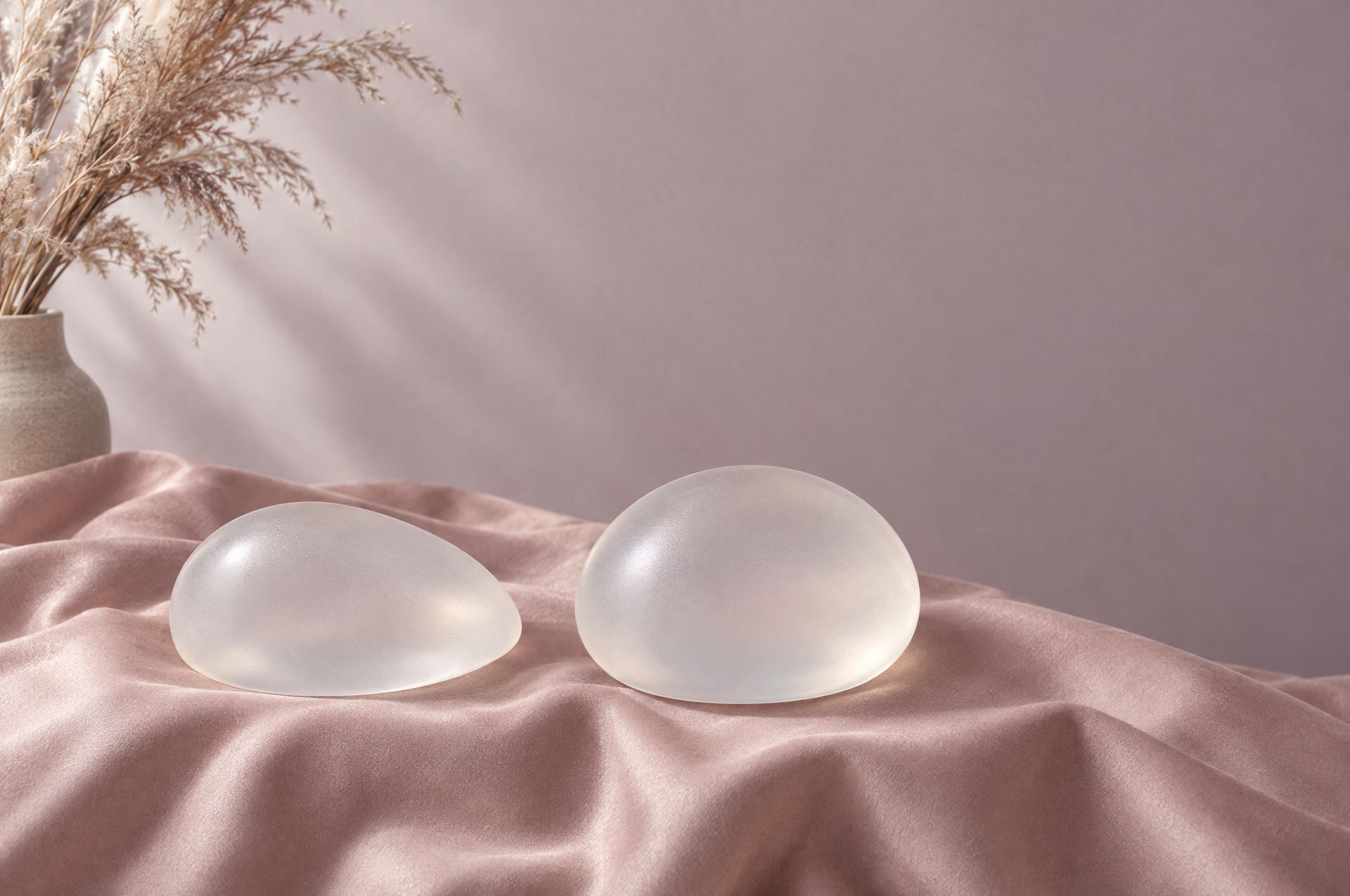
Implants offer particular advantages when a more noticeable augmentation is desired or when the additional volume needs to be as precisely predictable as possible. There is not just one single surgical technique. BRST offers different implant-based procedures that differ in terms of the access route, the achievable implant volume, and how gently the tissue is treated.
Mia Femtech™
With Mia Femtech™, access is through a small incision in the armpit crease. The tissue is stretched in a controlled manner using a specially developed balloon before the implant is inserted. This means no access scar is created on the breast itself. BRST was one of the first clinics in Switzerland to introduce Mia Femtech™.
Motiva Preserve
Motiva Preserve also follows a tissue-sparing approach but, thanks to access through the inframammary fold, allows more flexibility in terms of achievable implant volume.
Fat Transfer vs. Implant: The Key Differences
Fat Transfer | Implant | |
|---|---|---|
Volume increase | Rather moderate | More significant augmentation possible |
Volume predictability | More limited, as not all transferred fat survives permanently | Generally more predictable |
Foreign body | No | Yes |
Natural feel | Own fat tissue | Very natural feel possible depending on anatomy and implant |
Body fat required | Yes | No |
Asymmetries | Targeted volume balancing possible | Different volume planning possible |
Scars | Small access points for liposuction and transfer | Depends on the implant method |
Further treatment | A repeat fat transfer may be advisable | A later implant exchange or removal may become necessary |
Design options | Mainly volume and contour | Volume, projection and shape more controllable |
BRST considers factors including breast shape, existing tissue, skin quality, breast base and desired volume when choosing an implant-based method. It is precisely this individualised planning that determines whether the result looks harmonious.
What About Scars, Healing and Risks?
Both the scars and the recovery time depend on the chosen method. With a fat transfer breast augmentation, small access points are created on the breast and at the sites where fat is harvested. Accordingly, both the breast and the donor regions need to heal. With implants, the scar location depends on the procedure: with Mia Femtech™, the approximately 2.5-centimetre access point is in the armpit crease, while with Motiva Preserve it is in the inframammary fold.
Both treatments are surgical procedures and carry potential risks. With fat transfer, it is particularly relevant how much of the transferred fat tissue survives permanently; in addition, cysts or calcifications may develop. With implants, there are implant-specific risks such as capsular contracture, positional changes or the need for a later follow-up procedure. Both Mia Femtech™ and Motiva Preserve are designed to enable a faster recovery than a traditional breast augmentation. Which recovery time and risks apply to you personally depends on the treatment, your anatomy and your individual healing process, and will be discussed in detail during the medical consultation.
Which Looks More Natural: Fat Transfer or Implant?
Many women want a breast where the augmentation is as imperceptible as possible. It should look harmonious not only in the mirror but also feel natural during movement and touch.
Fat transfer brings good prerequisites for this, as it involves the body’s own tissue. It can blend softly into existing contours and is particularly suited for subtle changes. An implant, however, need not look artificial by any means.
With implant-based breast augmentation, the naturalness depends significantly on whether the implant shape, size, placement and the individual anatomy are well matched. A very slim patient with little breast tissue, for example, requires different planning than a patient with a broader breast base and more tissue of her own.
Our goal at BRST is therefore not the greatest possible change, but a result that blends harmoniously into your natural proportions.
Which Method Is Better Suited for Breasts of Different Sizes?
Almost no woman has two perfectly identical breasts. Small differences are natural and usually hardly noticeable. However, when the asymmetry is pronounced, it can be distressing in everyday life - for example, because bras or clothing fit differently on each side, or because one breast appears visibly fuller or lower.
For smaller volume differences, fat transfer can be used very precisely. For larger differences, differently sized implants, a lift, or combined procedures may be advisable. More information is available at correction of breast asymmetry. This is precisely why pronounced breast asymmetries should not be planned like a standard bilateral breast augmentation.
Do I Need an Implant If I Am Very Slim?
For a breast augmentation with fat transfer, sufficient fat must be available for harvesting. Especially in very slim patients, this can limit the possibilities. An implant does not depend on available fat deposits. However, the desired volume must still match the anatomical conditions. Skin quality, breast base, and existing breast tissue set natural limits.
That is why, even with implants, bigger is not automatically better.
At BRST, the selection is not made according to standard sizes but based on individual proportions and the desired outcome.
Which Lasts Longer: Fat Transfer or Implant?
There is no simple answer here either.
A portion of the successfully integrated fat can remain a long-term part of the breast. However, how much fat is retained varies individually. Moreover, fat tissue can change with later weight fluctuations.
An implant, on the other hand, has a defined volume. Nevertheless, breast implants should not be understood as a decision “for ever,” as check-ups or possibly further procedures may become necessary over the course of a lifetime.
For Motiva implants, both the question of longevity and the possibility of a later implant exchange are expressly part of the patient information provided by BRST.
Fat Transfer or Implant After Pregnancy and Breastfeeding?
After pregnancy and breastfeeding, many women experience their breasts differently than before. Often, fullness is lacking primarily in the upper breast area. In other cases, the skin has lost elasticity or the breast has visibly dropped. Some women describe the feeling that the breast no longer really fits the rest of their body.
Which treatment makes sense depends on what has actually changed. If volume is mainly lacking, both fat transfer and implants may be options. If there is also significant excess skin, augmentation alone may not be sufficient. In that case, a breast augmentation with a gentle breast lift may be advisable.
It is important to note: a treatment should not aim to match a supposed ideal. Rather, it is about working together to determine which change could help you feel comfortable with your breasts again.
Which Method Is Right for Me?
Perhaps you are already leaning toward fat transfer because you do not want a foreign body. Perhaps you prefer the greater predictability of an implant. Or you may be completely undecided. An initial orientation can help:
Fat transfer may be right for you if …
- you desire a rather moderate augmentation,
- you consciously wish to avoid an implant,
- sufficient fat tissue is available,
- you want to specifically harmonise individual areas of the breast, or
- a moderate size difference needs to be balanced.
An implant may be right for you if …
- you desire a more predictable and noticeable volume increase,
- the desired volume needs to be as precisely plannable as possible,
- little fat tissue is available,
- shape and projection need to be changed more significantly, or
- your anatomical starting point cannot be adequately addressed with fat transfer alone.
And sometimes the answer is: not either-or
Especially with more complex starting situations, it can make sense not to think in terms of “fat transfer or implant.” What matters is the desired result.
With breasts of different sizes, unusual breast shapes, or additional excess skin, individualised and possibly combined solutions may be necessary.
Why the Personal Consultation Is So Important
Before-and-after photos, testimonials, and comparisons on the internet can help with initial orientation. At the same time, the abundance of information can also be unsettling, because other women’s results cannot be directly applied to your body. Perhaps you come to us with a clear desired size. Perhaps you only know that you want to feel more comfortable in your body again. Both are perfectly fine.
During the consultation, we therefore take time for your questions and also for any concerns: How natural will the breast feel? What scars will there be? How much change is right for you? And how can the procedure be reconciled with your profession, your family, or your sporting activities?
At BRST, we analyse your breast shape, your proportions, your skin quality and the existing tissue, among other factors. For implant-based treatments, a 3D simulation can additionally be used to better evaluate different possibilities and develop realistic expectations about the result. We specialise in aesthetic and reconstructive surgery of the female breast. PD Dr. med. Farid Rezaeian and Dr. med. Martina Schneider combine plastic-reconstructive breast surgery with modern, tissue-sparing techniques.
Our goal is not to steer you toward a particular method or to give you as much volume as possible. Together, we want to find out which change suits your body, your daily life, and your personal expectations - so that you can make a decision you feel confident and comfortable with.

Do you have any questions?
Get in touch with us.