
When the nipples point inward instead of protruding naturally, it can be unsettling - in everyday life, in intimate moments, while breastfeeding, in how you feel about your own body. So-called inverted or retracted nipples are not uncommon; they occur in varying degrees and can affect women at any age. Some of these breast malformations are congenital, while others appear later in life.
What matters most: today there are safe, modern and individually tailored options for correcting inverted nipples - with an eye to a natural look, sensitivity and a result that feels right. At BRST in Zurich, we combine thorough diagnostics with gentle corrections to achieve an outward-pointing, natural-looking nipple. Arrange a personal appointment and let us advise you in a relationship built on trust.
What are inverted nipples?
Inverted nipples are nipples (mammillae) retracted on one or both sides that do not protrude outward, or do so only temporarily. Many of those affected experience this breast malformation primarily as an aesthetic burden; depending on the degree, functional aspects may also play a role, such as difficulty breastfeeding or recurring local irritation. In particularly pronounced cases, the term "retracted nipples" is also used.
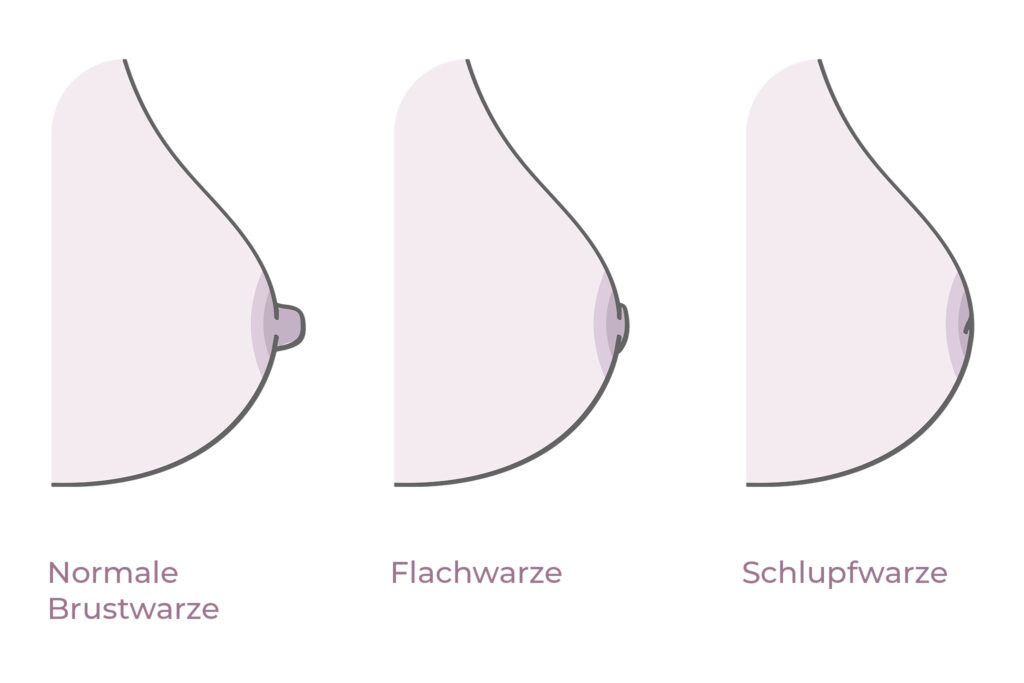
Inverted nipples should be distinguished from flat nipples. In this case, the nipples do not protrude beyond the areola. They are considered a variant of normal shape and should not be confused with inverted nipples, where the nipple is pulled inwards.
Inverted nipples and flat nipples: degrees and differences
Inverted nipples show themselves in three typical degrees of severity:
- In a mild case, the nipple temporarily protrudes in the cold, on contact or with gentle pulling, and then recedes again.
- Severity 2:
Moderately deep indentations can be manually reshaped, but they do not remain stable. - In the case of an inverted nipple, the nipple remains permanently turned inwards and barely reacts even to stimulation.
The stage present is clarified in an investigation; the recommendation for conservative or operative steps is based on this.
Causes: Why do people get inverted nipples?
Various factors can play a role in the development of inverted nipples. The most common cause is an anatomical peculiarity.
- Congenital peculiarities of the milk ducts and connective tissue
Frequently, shortened milk ducts or tight connective tissue strands pull the nipple inwards. This anatomical variation often exists since puberty and is usually medically harmless, but depending on its severity, is perceived as aesthetically displeasing. - Hormonal phases: puberty, pregnancy, menopause
Hormonal changes affect tissue elasticity and gland volume, which can either intensify a previously mild indentation or make one appear for the first time. Many changes during these phases are reversible – expert medical assessment can provide clarity. - Inverted nipple in old age
As age increases, tissue tension decreases, connective tissue becomes firmer or thinner, and the nipple can retract further inwards. This development is common, but should be investigated if it is new and occurs without a discernible cause. - Scars and scarring after inflammation or procedures
Local inflammation, abscesses or previous operations can lead to scars that pull the nipple inwards. In such cases, a targeted, gentle correction helps to release the tensile forces and shape the nipple stably outwards. - Functional causes related to the period of breastfeeding and nursing
During breastfeeding, irritation, minor injuries or recurrent inflammation can alter the tissue. Good care and early treatment of discomfort prevent scarring; in the case of existing retraction, we advise on appropriate options. - Trauma, pressure or piercings
External factors such as repeated pressure, injuries, or piercings rarely cause changes in connective tissue that draw the nipple inwards. An individual medical history helps to identify such triggers and plan the appropriate treatment. - Rare diseases - warning signs of new onset retraction
If a previously normal nipple suddenly retracts without a clear cause, it should be medically investigated. Rare causes such as inflammatory processes or – very rarely – diseases related to the mammary gland must be reliably ruled out.
Is breastfeeding possible with inverted nipples?
Breastfeeding often possible with slightly pronounced inverted nipples, especially if flat nipples are predominant and the nipple protrudes outwards when stimulated. Helpful are good breastfeeding preparation, guidance from a lactation consultant, and, if necessary, nipple shields which facilitate latching the baby.
Breastfeeding is made difficult by pronounced inverted nipples., because the baby can latch onto the nipple less effectively. In these cases, targeted correction – conservative or surgical – can improve the initial situation. Individual assessment before a planned pregnancy is important so that options and limitations can be realistically discussed.
Yes, men can also have inverted nipples.
Even in men, this can be caused by shortened connective tissue strands, inverted nipples occur. Most of the time, it's a cosmetic issue, but occasionally it can lead to irritation or inflammation, as secretions can build up in the retracted area. A small, targeted correction is also possible for men. and is planned depending on complaints and the desire for harmonisation.
Can I correct inverted nipples myself?
If inverted nipples appear for the first time or change suddenly, this should First medically clarified This way, we rule out rare but relevant causes and can assess which conservative steps are sensible.
- Nipple formers (shields) under clothing
Shallow plastic shells exert gentle, even pressure on the areola and can gradually train the nipple to protrude outwards. They are particularly suitable for mild inversions and must be worn regularly over several weeks. Expectation: often improvement, but not always permanent. - Suction devices/nipples for temporary vacuum
Small devices briefly create a vacuum, drawing the nipple outwards. With consistent use, the effect can stabilise, but the recurrence rate varies depending on the severity. Skin care and breaks are important to avoid irritation. - Manual techniques and gentle massage
Regular, gentle stretching at the junction of the nipple and areola can make the tissue more pliable. Benefits and limitations are individual; gentleness, hygiene, and patience are crucial. Pain, redness, or cracks are a stop signal. - Nipple shields for breastfeeding support
Nipple shields can make latching easier if the baby has difficulty gripping the nipple. They do not permanently correct inversion but improve function during breastfeeding. Breastfeeding support can help with correct usage. - Nipple piercing
A horizontally placed piercing can mechanically „fix“ the everted nipple, making inversion more difficult. Advantages include immediate visibility and a potentially stabilising effect; risks include infection, irritation, pressure pain, and scarring. This option should only be considered after professional assessment, in a hygienic studio, and with close aftercare. - Taping/Protective caps for short-term stabilisation
Soft shells or skin-friendly plasters can temporarily support an inverted nipple. This is suitable as a temporary solution, but does not replace long-term therapy. Skin compatibility and regular changing are important.
When is treatment for inverted nipples advisable?
Your personal level of suffering is decisive – regardless of how strongly the external enforcement appears. If you feel insecure about your appearance, have problems with breastfeeding, or experience recurring irritation, A correction of inverted nipples may be advisable.
Together, we will examine conservative options and discuss whether and when surgical correction is medically advisable, safe, and realistic. A small, targeted procedure can release the retracting structures and permanently shape the nipple outwards – with an inconspicuous scar and clear information regarding sensation and breastfeeding ability.
Modern treatment options for inverted nipples
If the withdrawal is moderate to severe or conservative measures do not lead to a stable outcome, We recommend surgical correction. The aim is to achieve a natural shape while preserving sensation as much as possible.
We carefully resolve the inward-pulling structures over a small, discreet cut. Depending on the individual situation, a technique can be chosen that protects the milk ducts as much as possible to preserve breastfeeding ability. The procedure is usually carried out as an outpatient procedure under local anaesthetic or a short general anaesthetic, and recovery is usually rapid.
Temporary protective caps stabilise the new position; swelling and bruises subside in the first few days. We will advise you individually on activity, sports breaks, and scar care to ensure the result remains stable for a long time.
Trustworthy advice and planning at BRST in Zurich
A good decision begins with a thorough specialist consultation. At BRST, we specialise in breast surgery. We analyse your anatomy, tissue quality and the severity of the inversion, discuss your expectations regarding shape, sensitivity and – if relevant – breastfeeding ability, and plan a realistic, individualised approach with you. This includes clear information on possibilities, limitations, risks and aftercare, as well as an open discussion as to whether conservative steps are sufficient or minor surgery is advisable.
Nipple correction from the expert: We'll be happy to advise you!
Inverted nipples are common – and treatable. Whether it's flat nipples with a slight inversion or pronounced inverted nipples of the breast: what matters is how you feel about them. Modern, individually tailored treatments allow for natural, stable results. If you desire a change, we at BRST in Zurich will advise you personally and confidentially – from the initial consultation to post-care.